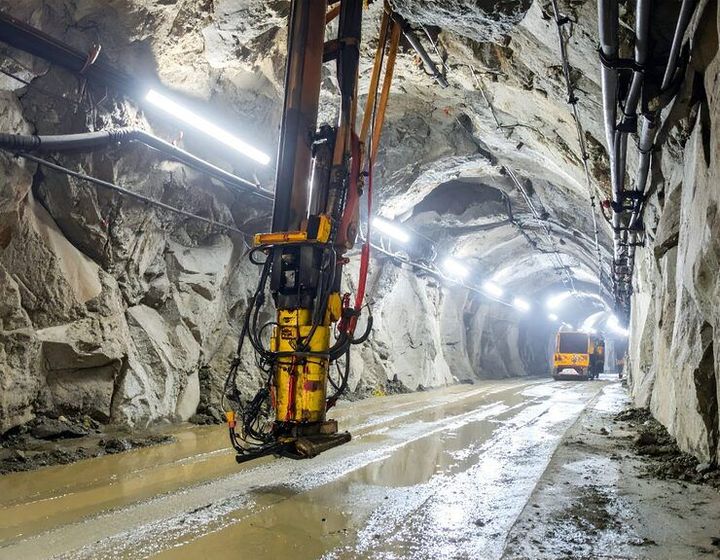
Tunnel Boring Machines: Overview of Components and Tunneling Processes
Tunnel Boring Machines, often called TBMs, are large mechanical systems designed to excavate underground passages through soil, rock, or mixed ground.
They are used for transportation tunnels, water infrastructure, utility corridors, drainage systems, and other underground construction. A TBM advances through the ground with a rotating cutting system while other equipment removes excavated material and supports the newly created tunnel.
Mechanized tunneling developed from earlier tunneling machines and shield concepts. Engineering advances have expanded their use across different geological conditions. Modern TBMs can be configured for hard rock, soft ground, high groundwater pressure, or mixed formations, so their design depends heavily on the ground expected along the route.
Main TBM Components
A TBM contains several connected systems that work together. The cutterhead is the rotating front section that breaks or cuts the ground. Behind it, the shield or main body protects the excavation area and contains equipment for steering, propulsion, and ground control.
Other important components include:
- Thrust cylinders that push the machine forward.
- Grippers or reaction systems used by certain hard-rock machines.
- Conveyors, screw conveyors, or slurry systems that move excavated material away.
- Segment erectors that place precast lining segments in shield-driven tunnels.
- Guidance equipment that helps maintain the planned tunnel alignment.
- Hydraulic, electrical, ventilation, and monitoring systems.
Common TBM Types
Different geological conditions require different approaches. Hard-rock TBMs commonly use disc cutters that fracture rock as the cutterhead rotates. Earth pressure balance machines are designed for many soft-ground applications and use controlled pressure at the tunnel face to help maintain stability. Slurry machines use a pressurized fluid circuit to support the face and transport excavated material.
Some projects use single-shield or double-shield machines, particularly where rock conditions and lining requirements make these configurations suitable.
| TBM type | Typical ground | Main feature |
|---|---|---|
| Hard-rock TBM | Strong rock | Disc cutters fracture rock |
| Earth pressure balance | Soft to mixed ground | Controlled pressure supports the face |
| Slurry TBM | Water-bearing soft ground | Pressurized slurry supports excavation |
| Single-shield | Various rock conditions | Shield protects the excavation zone |
| Double-shield | Suitable hard-rock conditions | Supports continuous excavation and lining |
Importance
TBMs matter because underground construction can create transport, water, drainage, and utility routes without requiring the entire route to be opened from the surface. This can be particularly important in dense urban areas where roads, buildings, railways, rivers, and existing infrastructure occupy the ground above.
Problems TBMs Help Address
A tunnel project must manage several risks at once. Ground movement can affect nearby structures, groundwater can enter the excavation, and unexpected geology can change how the machine behaves. TBM systems provide controlled excavation and monitoring so project teams can respond to changing conditions.
How the Tunneling Process Works
A typical process begins with geological investigation and route planning. Engineers study boreholes, geological maps, groundwater conditions, and other site information before selecting a suitable machine configuration.
The broad sequence usually includes:
- Launching the TBM from a prepared shaft, portal, or underground chamber.
- Rotating the cutterhead to excavate the ground.
- Removing excavated material through a conveyor, screw system, or slurry circuit.
- Steering the machine according to the planned alignment.
- Installing tunnel lining as required by the machine and project method.
- Monitoring ground pressure, machine performance, alignment, and surrounding conditions.
- Continuing the cycle until the planned drive is completed.
In many shielded tunneling systems, precast concrete segments are installed behind the shield. The segments form a ring that supports the tunnel and creates the internal passage.
Recent Updates
Developments from 2024–2026 show continued attention to automation, digital monitoring, specialized machine designs, and lower-impact construction methods. The International Tunnelling and Underground Space Association has highlighted work involving integrated sensing, automated lining equipment, AI-supported processes, and technologies for difficult geological conditions.
Large-diameter machines are also being used for technically demanding projects. A 13.5-meter-diameter TBM used on Panama Metro Line 3 crossed beneath the Panama Canal in complex ground with high groundwater pressure, while digital monitoring tracked data from thousands of machine sensors.
Automation is another continuing trend. Recent tunneling research includes AI for machine operation, maintenance, and control, together with technologies intended to reduce energy use.
Sustainability is influencing tunnel design as well. Recent projects have examined lower-carbon lining materials, alternative reinforcement approaches, and technologies intended to improve durability.
Tools and Resources
Understanding TBMs can involve several types of technical resources. The ITA website provides technical publications, tunneling guidance, industry activities, and information about current developments. Geological maps and ground investigation reports help explain why machine selection changes from one project to another.
Digital tools can also support tunnel planning and operation. Common categories include:
- Tunnel alignment and surveying software for route control.
- Geological and geotechnical modeling tools for ground assessment.
- TBM monitoring dashboards for machine data and operating conditions.
- Tunnel lining design tools for segment geometry and structural checks.
- Logistics tracking systems for excavation material and tunnel components.
- Calculators for tunnel diameter, excavation volume, lining geometry, and material quantities.
FAQs
What is a Tunnel Boring Machine?
A Tunnel Boring Machine is a mechanized excavation system that cuts through underground ground and moves excavated material away from the tunnel face. Many TBMs also include systems for steering, monitoring, and installing tunnel support or lining.
How do Tunnel Boring Machines work?
Tunnel Boring Machines rotate a cutterhead against the ground while propulsion systems move the machine forward. Excavated material is transported away, and lining or ground support is installed according to the tunneling method.
What are the main Tunnel Boring Machine components?
Key components include the cutterhead, shield or main body, propulsion systems, excavation-material removal equipment, guidance equipment, hydraulic and electrical systems, monitoring equipment, and, for many shielded machines, a segment erector.
Which Tunnel Boring Machine is used for soft ground?
Earth pressure balance and slurry TBMs are commonly used for soft or water-bearing ground, depending on geological and groundwater conditions. The appropriate configuration is determined through site investigation and project design.
Why are Tunnel Boring Machines important for cities?
TBMs can create underground routes while limiting the amount of surface excavation along the tunnel alignment. This can help accommodate rail, road, water, drainage, and utility infrastructure where surface space is limited.
Conclusion
Tunnel Boring Machines combine excavation, steering, material removal, monitoring, and tunnel support systems into a coordinated underground construction process. Their components and operating methods vary according to ground conditions, tunnel size, and project requirements. Recent developments are increasingly focused on automation, sensing, digital control, specialized designs, and lower-impact construction methods. Understanding these fundamentals provides a useful foundation for learning how modern tunneling projects are planned and carried out.