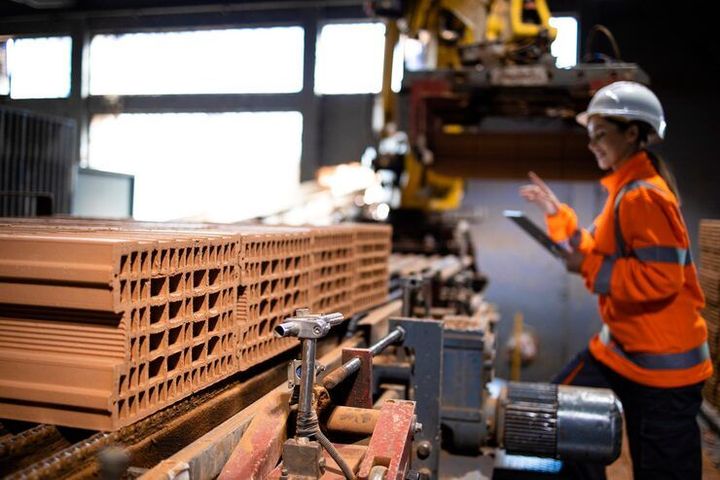
Industrial Brick Machine Basics: Learn About Brick Manufacturing Processes
An industrial brick machine is equipment used to shape and form bricks or blocks as part of a controlled manufacturing process.
Depending on the material and brick type, the equipment may use pressing, vibration, extrusion, molding, or a combination of these methods. Industrial production reduces reliance on entirely manual forming and allows the manufacturing stages to follow a more consistent sequence.
Brick manufacturing has existed for thousands of years, beginning with simple hand-shaped clay units that were dried in the sun. Later, kilns made it possible to produce fired bricks with greater durability. Industrialization introduced mechanical mixers, presses, extruders, cutters, conveyors, and automated controls, creating the modern production systems used in many brick plants.
The exact process depends on the material. Traditional fired clay bricks generally involve preparing clay, forming the brick, drying it, and firing it in a kiln. Concrete and other cement-based products can follow a different route, where measured materials are mixed, molded under pressure or vibration, and cured rather than fired.
Main Stages of Brick Manufacturing Processes
Although equipment layouts differ, many brick manufacturing processes follow a sequence similar to this:
- Raw material preparation
- Material mixing and conditioning
- Brick forming or molding
- Cutting or sizing where required
- Drying or curing
- Firing for suitable clay products
- Inspection and handling
An industrial brick machine normally performs the forming stage, although modern production lines can connect several machines so that material movement and processing occur with limited manual handling.
Common Types of Brick Machines
Industrial brick machines can be grouped according to the forming method and material. Hydraulic or mechanical presses compact prepared material inside a mold. Vibration-based machines use controlled vibration together with pressure to shape certain concrete or cement-based products.
Extrusion systems push prepared clay through a shaped opening to create a continuous column that can then be cut into individual units. Automatic molding systems can also use programmable controls to coordinate feeding, pressing, demolding, and material movement.
Importance
Why Industrial Brick Machines Matter
Bricks remain important construction materials for walls, partitions, paving applications, and other building uses. Consistent dimensions and controlled manufacturing processes can make handling and construction more predictable.
An industrial brick machine also addresses some practical limitations of manual forming. Manual production can involve differences in mold filling, pressure, shape, drying, and handling. Mechanical equipment can repeat defined movements and processing conditions, while operators monitor the system and make adjustments when necessary.
Energy use is another important issue. Research into brick manufacturing has identified kiln technology, production capacity, and fuel type as major factors affecting energy consumption in fired-brick production. This makes kiln design and operating practices an important part of discussions about more efficient brick manufacturing.
Material Preparation and Product Consistency
Material preparation has a direct relationship with the forming stage. Clay may need crushing, screening, grinding, moisture adjustment, and mixing before it enters an extrusion or molding system. Concrete-based products require measured aggregates, cementitious materials, water, and sometimes other approved components.
The forming machine must work with material that has suitable moisture and consistency. If the mixture is too dry, it may not compact properly. If it contains excessive moisture, handling and drying can become more difficult.
Environmental and Workplace Considerations
Brick production can involve dust, heat, moving machinery, fuel combustion, and material handling. Appropriate ventilation, machine guarding, personal protective equipment, housekeeping, and operating procedures are therefore relevant to industrial environments.
Research has also examined mechanized brick production as a way to address energy use, repetitive manual activities, machine ergonomics, and resource use. Environmental considerations are particularly relevant to fired bricks because the kiln stage requires substantial thermal energy.
| Manufacturing stage | Main purpose | Typical equipment |
|---|---|---|
| Raw material preparation | Prepare consistent feed material | Crusher, grinder, screen |
| Mixing | Combine materials and adjust consistency | Mixer, pug mill |
| Forming | Create the brick shape | Press, mold, extruder |
| Cutting | Divide continuous material into units | Wire cutter, cutting system |
| Drying | Remove moisture | Drying chamber or controlled area |
| Firing | Harden suitable clay bricks | Kiln |
| Handling | Move finished units | Conveyor, pallet system |
Recent Updates
Greater Use of Automation
Between 2024 and 2026, research and development in brick and construction automation continued to focus on digital controls, robotics, coordinated machine movement, and process monitoring. A 2026 study examined industrial robotic systems for automated bricklaying, showing how digital models, robot programming, and automated placement are being investigated for construction applications.
This development is related to, but separate from, brick manufacturing itself. Manufacturing automation focuses on producing consistent units, while robotic bricklaying focuses on placing those units during construction.
Energy Efficiency and Cleaner Production
Energy efficiency remains an important theme in brick manufacturing. Studies have investigated improved kiln technologies, alternative production methods, and changes in material composition to reduce environmental impacts.
Recent research has also examined the use of industrial waste materials in fired bricks. A 2025 study investigated waste foundry sand and cast-iron slag as partial material substitutions and reported changes in embodied energy and emissions under the tested conditions. Such research does not mean every waste material is suitable for brick production; material composition, safety, strength, durability, and applicable standards must be evaluated separately.
Updated Brick Standards
Standards are also evolving. In India, information published by the Bureau of Indian Standards in 2025 highlighted brick standards associated with dimensions, material performance, and sustainable construction practices. A revised IS 1077 specification has also been reported with changes involving modular dimensions, non-modular sizes, warpage, modulus of rupture, and initial water absorption requirements.
These developments show that modern brick manufacturing involves more than machine operation. Material preparation, dimensional control, testing, energy use, and applicable construction standards are all part of the wider production picture.
Tools and Resources
Production Planning Tools
Manufacturers and learners can use production calculators or spreadsheet templates to estimate material quantities, batch sizes, production cycles, drying requirements, and equipment capacity. A simple spreadsheet can organize inputs such as brick dimensions, batch weight, moisture content, cycle duration, and daily operating hours.
Measurement and Quality Tools
Common measurement resources include dimensional gauges, weighing equipment, moisture meters, compression-testing equipment, and water-absorption testing methods. The appropriate testing method depends on the type of brick and the applicable standard.
Digital Monitoring
Modern industrial systems may use programmable logic controllers, sensors, digital displays, and data-logging systems to monitor equipment conditions. These technologies can help operators observe production parameters and identify changes in machine operation.
For people researching brick manufacturing processes, standards organizations, technical publications, engineering databases, equipment manuals, and educational materials from universities can provide useful background information. The relevant national or regional building-material standards should be checked when technical specifications are important.
FAQs
What is an industrial brick machine?
An industrial brick machine is equipment used to form bricks or blocks from prepared materials. Depending on the design, it may use pressing, molding, vibration, or extrusion.
How do industrial brick manufacturing processes work?
Industrial brick manufacturing processes generally begin with raw material preparation and mixing. The material is then formed, dried or cured, and, for suitable clay bricks, fired in a kiln before inspection and handling.
What materials are used in an industrial brick machine?
Materials depend on the machine and product type. Clay is commonly used for fired bricks, while concrete-based machines may process cementitious materials, aggregates, water, and other specified components.
Does every industrial brick machine use a kiln?
No. A kiln is generally associated with fired clay products. Concrete and some other molded products can harden through controlled curing rather than high-temperature firing.
Why is automation used in brick manufacturing processes?
Automation can coordinate repeated activities such as material feeding, forming, cutting, conveying, and monitoring. Modern research is also examining digital controls and robotics for manufacturing and construction applications.
Conclusion
An industrial brick machine is one part of a broader manufacturing system that can include material preparation, mixing, forming, drying or curing, firing, inspection, and handling. Brick manufacturing processes vary according to the material, product design, and production method. From 2024 through 2026, automation, energy efficiency, digital monitoring, material research, and updated standards have remained important areas of development. Understanding these stages provides a clearer view of how modern brick production connects machinery, materials, quality control, and construction requirements.