Dubai Hotel Stay Guide: Understanding Accommodation Options, Locations, and Amenities
A Dubai hotel stay can vary considerably depending on accommodation type, location, room arrangement, and available amenities.
Dubai has developed into a major international destination with hotels ranging from compact city properties and apartment-style accommodation to large resorts and extended-stay options. Understanding these differences can help travelers interpret hotel listings, compare locations, and understand what to expect before making travel arrangements.
Context
Understanding Dubai Hotel Accommodation
Dubai’s hotel sector developed alongside the emirate’s growth as a business, tourism, and leisure destination. As visitor numbers increased, accommodation expanded across different parts of the city and began serving different travel needs, including short city visits, business trips, family holidays, and longer stays.
The accommodation landscape now includes traditional hotels, resorts, hotel apartments, boutique properties, and extended-stay accommodation. Each type can have different room layouts, facilities, dining arrangements, recreation areas, and policies.
According to Dubai Department of Economy and Tourism data, Dubai had 154,016 hotel rooms across 832 establishments at the end of 2024. The city continued expanding its accommodation capacity in 2025, reaching 154,264 rooms across 827 establishments by the end of that year.
Main Accommodation Types
Traditional hotels generally provide private guest rooms with shared or property-wide facilities. They can range from smaller properties to large buildings with restaurants, meeting areas, pools, fitness facilities, and other amenities.
Resorts are generally designed around leisure stays and may include pools, landscaped areas, recreational facilities, restaurants, and beach access where applicable. Hotel apartments can provide additional living space, such as a kitchen or separate sitting area, which may be useful for longer stays.
Extended-stay properties are structured around guests who remain for several days or weeks. Their layouts may include larger rooms, kitchen facilities, laundry arrangements, and additional residential features.
Importance
Why Location Matters
Dubai is geographically spread across several districts, and the location of accommodation can influence how easily travelers reach attractions, workplaces, shopping areas, beaches, airports, and public transportation.
Downtown Dubai is associated with major attractions, commercial areas, and urban landmarks. Dubai Marina and Jumeirah are associated with waterfront environments, while Deira and Bur Dubai provide access to older commercial and cultural areas. Areas around Dubai International Airport can be practical for short visits or travelers with early departures.
The following table provides a general comparison of accommodation characteristics across commonly recognized areas.
| Area | General Character | Common Accommodation Types | Useful For |
|---|---|---|---|
| Downtown Dubai | Urban and central | Hotels, upscale properties, apartments | City attractions and business |
| Dubai Marina | Waterfront and residential | Hotels, resorts, apartments | Leisure and waterfront stays |
| Jumeirah | Coastal and residential | Resorts, hotels, villas | Beach-oriented trips |
| Deira | Historic commercial district | Hotels, apartments | Markets and traditional areas |
| Bur Dubai | Historic and central | Hotels, apartments | Cultural areas and city access |
| Dubai Airport Area | Transport-oriented | Hotels, short-stay properties | Transit and short visits |
| Palm Jumeirah | Island and resort-focused | Resorts, hotels, apartments | Leisure-oriented stays |
Understanding Amenities
Amenities are another important part of a Dubai hotel stay. The facilities provided can differ according to the property type, room category, and location.
Common amenities may include:
- Swimming pools and fitness rooms
- Restaurants or dining areas
- Wi-Fi and in-room connectivity
- Air conditioning
- Housekeeping arrangements
- Parking facilities
- Meeting or business areas
- Children's facilities at selected properties
- Beach access at some coastal properties
- Kitchen facilities in selected apartment-style rooms
Travelers should distinguish between amenities included with a particular room and facilities located elsewhere within the property. A hotel may have several facilities while individual room categories may differ in what they provide.
Room Types and Stay Length
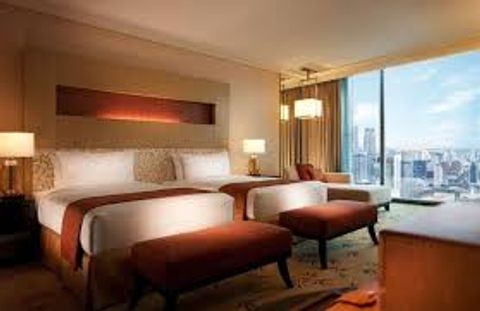
Room categories can include single rooms, double rooms, twin rooms, suites, studios, and apartment-style units. The terminology can vary between properties, so travelers should examine the stated bed arrangement and room dimensions rather than relying only on the category name.
Short stays may focus on convenient access to attractions and transportation, while longer stays can make room layout, kitchen facilities, laundry arrangements, and storage space more relevant. Families may also need to check occupancy rules and whether additional beds or connecting rooms are permitted.
Recent Updates
Growth in Dubai's Hotel Sector
Dubai's accommodation market continued to expand between 2024 and 2026. In 2024, average hotel occupancy reached 78.2%, while the city recorded 18.72 million international overnight visitors for the year. In 2025, international overnight visitation increased to 19.59 million, while average hotel occupancy reached 80.7%.
The accommodation supply also continued to change as new properties opened across different districts. This has increased the range of room types and locations that travelers can consider when planning a Dubai hotel stay.
Digital Check-In Developments
Technology has become a more visible part of hotel arrival procedures. In late 2025, Dubai introduced a citywide contactless hotel guest check-in initiative based on digital identification and biometric information, designed for participating hotels and holiday homes. Implementation depends on individual property integration.
This development reflects a broader movement toward digital arrival processes, mobile hotel applications, and electronic identity verification. Travelers should still check individual property instructions because procedures can vary.
Sustainability and Accommodation
Environmental practices have also received greater attention in Dubai's hospitality sector. In 2026, the Dubai Sustainable Tourism Stamp recognized 237 hotels, compared with 153 hotels in the previous cycle. The program considers areas such as energy efficiency, water conservation, and waste management.
For travelers, this means sustainability information may increasingly appear alongside traditional accommodation details. However, environmental recognition and individual hotel practices can differ, so specific property information remains relevant.
Tools and Resources
Official Tourism Information
The Dubai Department of Economy and Tourism provides information about tourism regulations, hotel classification, accommodation developments, and destination information. Visit Dubai provides destination information covering districts, attractions, transportation, and travel planning.
Maps and Transportation Tools
Digital map applications can help travelers understand the distance between a hotel and nearby attractions, metro stations, airports, beaches, and business districts. Looking at the surrounding road network and public transportation can provide additional context beyond the hotel address.
Hotel Comparison Platforms
Hotel comparison and reservation platforms can be used to examine room categories, property facilities, guest policies, location details, and review information. Travelers should read the actual room description because amenities and occupancy conditions may vary between room categories within the same property.
Planning Templates
A simple accommodation checklist can include:
- Property location
- Room type and bed arrangement
- Check-in and check-out conditions
- Available amenities
- Transportation access
- Parking arrangements
- Room occupancy limits
- Cancellation conditions
- Additional taxes or mandatory charges stated during reservation
Using the same checklist for different properties can make accommodation information easier to understand.
FAQs
What should I consider when planning a Dubai Hotel Stay Guide?
A Dubai hotel stay should be assessed through location, accommodation type, room arrangement, amenities, transportation access, and the expected length of the visit. These factors can affect how practical a property is for a particular itinerary.
Which locations are common for a Dubai hotel stay?
Downtown Dubai, Dubai Marina, Jumeirah, Deira, Bur Dubai, Palm Jumeirah, and areas around Dubai International Airport are among the locations with varied accommodation choices. Each area has a different surrounding environment and transportation profile.
What amenities are commonly included in Dubai hotels?
Common amenities include air conditioning, Wi-Fi, pools, fitness facilities, dining areas, parking, and housekeeping arrangements. The exact facilities depend on the property and room category.
How have Dubai hotel accommodations changed from 2024 to 2026?
Dubai's hotel inventory continued to expand, while digital check-in technology and sustainability initiatives became more visible. Hotel supply and visitor activity also remained substantial during this period.
Are hotel apartments different from traditional hotels?
Yes. Hotel apartments generally provide more residential-style layouts and may include kitchens, living areas, or additional space. Their facilities and occupancy rules vary by property.
Conclusion
A Dubai hotel stay can involve many accommodation types, locations, room arrangements, and amenities. Understanding the differences between districts and property categories provides useful context when interpreting accommodation information. Developments from 2024 through 2026 show continued expansion, increased use of digital processes, and greater attention to sustainability within Dubai's hospitality sector. Individual property details remain important because facilities, room conditions, and policies vary between accommodations.